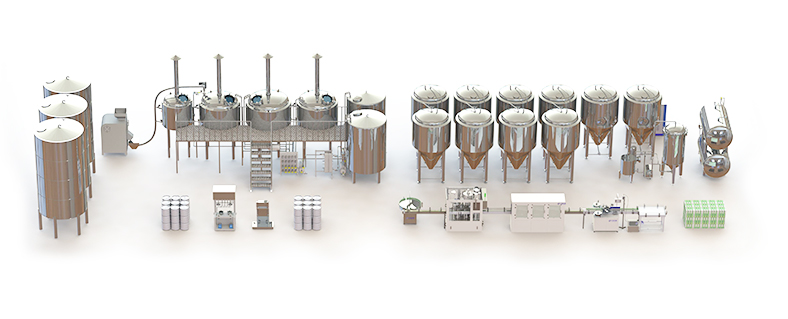
A turn-key brewery can fit a startup when the founder needs one supplier to coordinate the brewhouse, cellar, glycol, controls, piping, commissioning, and training. It is less attractive when the team already has strong process engineering and trusted local contractors. In 2025, U.S. craft production fell 4% to about 22.0 million barrels, while 60% of breweries reported lower production, so oversizing equipment deserves extra scrutiny. A startup should size equipment around realistic annual sales, tank occupancy, utility capacity, labor, and cash available after opening—not around the largest brewhouse it can finance.
The market backdrop makes equipment sizing more demanding than it was during the rapid brewery expansion of the 2010s. The United States had 9,578 craft breweries operating in 2025, down 2.9% from 2024, while craft volume sales fell 4%. Craft still represented 13.4% of U.S. beer volume, but a new brewery enters a market with many established taprooms, brewpubs, and packaged brands competing for the same drinking occasions.
That sales environment changes how a startup should look at a turn-key package. A 20 BBL brewhouse may look only moderately more expensive than a 10 BBL system on a supplier quotation, but brewhouse size affects fermenter volume, glycol capacity, hot-water storage, steam or gas demand, floor area, piping diameter, and packaging throughput. Equipment purchased for production that may not arrive for several years ties up capital before the brewery has recurring sales.
A more useful starting point is annual barrel output. One U.S. beer barrel equals 31 gallons. A brewery targeting 1,500 BBL in its first full year needs about 46,500 gallons of finished beer before allowing for process losses. If it brews 10 BBL batches, 150 equivalent finished batches are required; at 85% packaged or saleable recovery, the actual brewing requirement moves closer to 176 batch-equivalents.
Fermentation makes that calculation more restrictive. A 10 BBL brewhouse paired with four 10 BBL fermenters provides only 40 BBL of nominal cellar space, while six 20 BBL fermenters provide 120 BBL. If an ale occupies a fermenter for 14 days and a lager occupies it for 28 days, the same tank supports roughly twice as many annual ale cycles before cleaning time, maintenance, and scheduling gaps are included.
A brewhouse can finish a brew day in hours; a fermenter may stay occupied for two to four weeks. Buying more brewhouse capacity without enough cellar space rarely increases finished-beer output at the same rate.
For that reason, good turn-key engineering starts with a production schedule rather than a vessel count. The supplier should model weekly brews, average tank residence time, expected beer mix, double-batching plans, cleaning time, seasonal peaks, and spare capacity. A 2026 Brewers Association technical article notes that brewhouse extract efficiency below 80% can leave substantial room for material savings; a 10% improvement in extract efficiency may reduce malt use by roughly one 50-pound bag in a seven-barrel batch, depending on the recipe.
The package also needs to show where production bottlenecks move as volume increases. A startup operating two brew days per week may have little need for high automation, while a brewery planning two or three turns per day may benefit from automated valves, recipe controls, flow measurement, and more repeatable transfers. Extra automation raises the purchase price and adds sensors, actuators, PLC components, and software that will eventually need service.
| Area | What should be specified before purchase | Example sizing question |
|---|---|---|
| Brewhouse | Batch size, turns per day, heating method | Can a 10 BBL system complete 2 brews within the planned shift? |
| Cellar | Fermenter count, usable volume, beer residence time | Does 80 BBL of fermentation support the weekly brew plan? |
| Glycol | Peak cooling requirement, tank jackets, ambient conditions | Can several tanks crash-cool at the same time? |
| Hot liquor | Strike water, sparge water, cleaning demand | Is hot water available for the next brew without delaying CIP? |
| Packaging | Kegs, cans, bottles, hourly speed | Can packaging clear beer as quickly as the cellar releases it? |
Once vessel sizing is established, water becomes one of the first site limits to check. Brewers Association guidance has cited an average brewery water-use ratio of roughly 7 barrels of water for each barrel of beer, while better-performing breweries have reached ratios below 3:1. A startup producing 2,000 BBL per year at a 7:1 ratio could therefore use about 14,000 BBL, or 434,000 gallons, of water across brewing, cleaning, rinsing, packaging, and other plant uses.
That water later affects drainage and sewer requirements. Brewers Association wastewater guidance gives an example of a 10,000 BBL-per-year brewery operating 250 days annually at an 8:1 water ratio. With wastewater equal to 60% of incoming water, the model produces about 6,000 gallons of wastewater per operating day. At the example concentrations used in the manual, biochemical oxygen demand reaches about 400 pounds per day.
A turn-key supplier therefore needs to provide more than tank connection sizes. Site engineers need expected water flow, peak discharge, drain locations, equipment elevations, hot-water demand, cleaning volumes, and wastewater characteristics early enough to coordinate the building. Equipment that physically fits the room can still create expensive construction revisions when trench drains, slab thickness, floor slope, ventilation, or utility connection points were based on incomplete drawings.
Energy deserves the same treatment. Brewers Association energy guidance reports electrical consumption ranges of approximately 12–22 kWh per barrel and thermal use around 1.3–1.5 therms per barrel across breweries in its reference data. Smaller breweries often use more energy per barrel because refrigeration, lighting, pumps, controls, and other base consumption are spread across fewer barrels.
A 3,000 BBL brewery using 18 kWh per barrel would consume roughly 54,000 kWh annually for the brewery activities represented by that benchmark. Heating at 1.4 therms per barrel would add about 4,200 therms. Local utility rates can move those costs considerably, so a supplier's heating and cooling assumptions should be shown in measurable units rather than described only as “suitable for a 10 BBL brewery.”
The glycol system deserves particular attention because fermentation, cold conditioning, and crash cooling can overlap. A chiller selected around average demand may struggle when several fermenters need rapid cooling on the same day. The supplier should state coolant supply temperature, return temperature, design ambient temperature, pump flow, available head, glycol concentration, tank jacket area, and the number of vessels assumed to cool simultaneously.
The same level of detail should appear in the Brewery/Distillery/Winery All-In-One Solution proposal when several process systems are supplied together. “All-in-one” should describe the contracted scope, not simply the number of machines on the quotation. Buyers need to know who supplies interconnecting pipework, cable runs, insulation, platforms, field instruments, commissioning materials, and final utility hookups.
The contract should separate supplier work from site work in plain language. At minimum, the founder should be able to identify who handles:
-
process piping and sanitary welding;
-
glycol headers, insulation, and tank drops;
-
electrical panels, field wiring, and local electrical inspection;
-
steam or gas connections and burner setup;
-
compressed air for pneumatic valves or packaging equipment;
-
water treatment and incoming pressure requirements;
-
CIP equipment, chemicals, and commissioning procedures;
-
operator training, manuals, spare parts, and remote service.
Those boundaries matter because federal approval does not replace building or operating requirements. In the United States, a brewery or brewpub must qualify for a Brewer’s Notice before starting brewery operations, and TTB directs applicants to file through Permits Online after assembling the required documentation. TTB’s brewery startup guidance was updated in August 2025. State alcohol licensing, zoning, fire review, wastewater approval, food-service permits, and local construction rules may add separate requirements.
Equipment documentation can make those reviews easier. A supplier should provide vessel drawings, overall layout, utility schedules, electrical loads, piping information, equipment weights, tank operating volumes, pressure ratings, control architecture, and connection points. Sending this information after fabrication has started leaves less room to move a drain, enlarge an electrical service, change a doorway, or adjust a boiler specification without extra cost.
Freight and installation also deserve their own budget lines. A quotation that covers tanks at the factory may exclude unloading, rigging, forklift or crane rental, indoor positioning, field welding, electrical installation, insulation, travel expenses, accommodation for technicians, commissioning consumables, and replacement parts. A lower equipment price can disappear once several contractors are hired separately for work that another quotation already includes.
Startup cash should remain available after installation as well. If a project uses nearly all available funding before the first commercial batch, the brewery still needs malt, hops, yeast, chemicals, kegs or cans, payroll, insurance, utility deposits, marketing, taproom inventory, repairs, and working capital. The 2025 U.S. craft market data, where 60% of reporting breweries saw production decline, supports using conservative sales assumptions rather than building the first plant around uninterrupted growth.
Expansion can still be planned without buying every tank on day one. A startup can leave floor space for two additional fermenters, size glycol headers for later branches, reserve electrical panel capacity, place capped sanitary connections at suitable points, and make sure future tanks can physically enter the building. That approach costs less than purchasing unused stainless steel while keeping the site easier to enlarge.
Serviceability needs similar attention. Pumps, motors, bearings, temperature probes, pressure transmitters, valve seats, solenoids, contactors, and PLC parts eventually require replacement. Founders should ask for manufacturer and model information before purchase, then check whether common components can be sourced locally. A brewery that depends on one uncommon part for an essential transfer or cooling function can lose several production days while waiting for a replacement.
Acceptance testing gives the buyer a measurable way to close the project. Instead of accepting equipment because tanks hold water and the control screen powers on, the contract can require pump-flow checks, heating tests, cooling tests, temperature-control checks, valve sequencing, leak inspection, emergency-stop verification, CIP circulation, sensor calibration, and a documented water brew before the first commercial batch.
One final number can put the purchase in context: U.S. craft breweries produced about 22.0 million barrels in 2025, down 4% year over year, while the overall U.S. beer category fell 5.7%. A startup entering that environment has little reason to pay for capacity based mainly on optimistic volume forecasts. Equipment should be bought around a production model that shows batch frequency, tank days, saleable yield, water use, energy use, packaging rate, staffing, maintenance access, and enough remaining cash to operate after commissioning.