Why Unfiltered Chat Still Needs Community Guidelines
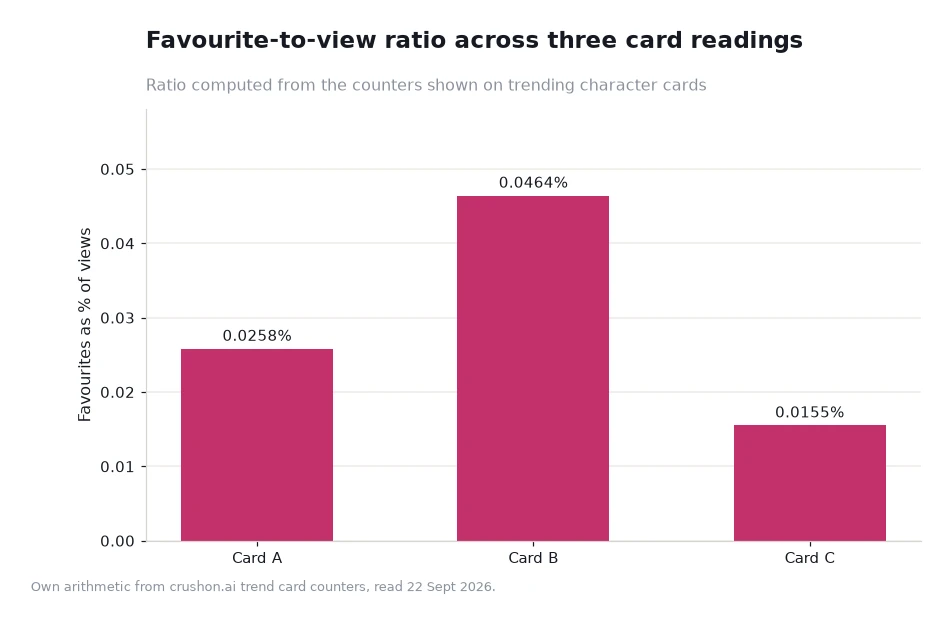
Unfiltered means the platform does not sanitise adult roleplay; it does not mean nobody decides where the edges are. The distinction matters because a product with no boundaries at all becomes unusable rather than free — discovery collapses, reports go nowhere, and the listings that hold attention best are the ones that quietly disappear. The evidence sits in the counters: cards keeping 2.58 favourites per 10,000 views and cards keeping 4.64 both sit in a band that curation, not chaos, produces.

Key takeaways
- The platform's own FAQ states that some limitations apply under its content and community guidelines, so latitude and rules coexist rather than cancel out.
- Every content page carries a report option, and [email protected] serves as both the reporting and compliance contact.
- Guidelines protect discoverability: a catalogue without a removal route loses the listings that convert best.
- Ratios in the observed band — 0.0258%, 0.0464% and 0.0155% on three card readings — differ by a factor of about three.
The trade-off stated plainly
Latitude is the product. A reader who wants a filtered, cautious conversation already has a thousand options, and an adult platform's reason to exist is that it does not start from a defensive position. Guidelines do not contradict that; they define where the product stops, so that everything inside the boundary can be explored without second-guessing the environment.
The failure mode of latitude without rules is not scandal, it is decay. Listings that attract reports go unchallenged, authors stop investing in quality because distribution is unreliable, and readers stop trusting the counters because nothing behind them is enforced. A removal route is what keeps a ratio meaningful.
The second reason is legal, and it is stated publicly. The platform carries an 18 U.S.C. §2257 compliance statement, last updated 8 February 2025, which describes its content as AI-generated text that depicts no real person and confirms that it does not produce images or video. That statement is the factual floor beneath every guideline: the debates about freedom that surround adult platforms do not apply here in the way people assume.
What the guidelines govern in practice
Three things, in the order a reader usually meets them. First, access: the platform is built for adults and labels its catalogue accordingly, with an explicit adult filter alongside filtered and unfiltered views. Second, content: what a listing may describe, which sets the boundary the FAQ refers to.
Third, process: what happens after a complaint. The content removal policy describes the reporting mechanism, and the complaints policy provides the escalation path when a report does not resolve the issue. Process is the unglamorous part and the one that decides whether a report is theatre or action.
There is a fourth effect that is easy to miss. Guidelines make a catalogue comparable. When listings are held to a baseline, a reader's shortlist gets shorter and the counters get more informative, which is why the trend cards can carry both views and favourites as meaningful signals rather than as decoration.
The measure of a workable boundary is that it is nearly invisible in ordinary use. Most readers never encounter it, because most listings are written well inside it, and the rules become visible only at the edges. A platform where guidelines are felt constantly is one where the baseline was drawn too tightly, which is a different failure from drawing it too loosely.
Process protects authors as well as readers. A public report route means complaints arrive as documented requests rather than as reviews, and a creator whose listing is removed has a stated basis to work from. Platforms that skip this stage push disputes into channels where the only outcome is noise, and authors respond by publishing less.
| Area | What latitude allows | What the guideline requires |
|---|---|---|
| Access | Adult content presented without a defensive tone | An explicit adults-only framing and filter |
| Catalogue | A wide range of premises and registers | A baseline that keeps listings comparable |
| Reports | No obligation to engage with content you dislike | A route to report it from the page where you found it |
| Escalation | The platform decides most questions internally | A published complaints process when a report stalls |
| Status of content | Any roleplay premise that meets the baseline | Disclosure that content is AI-generated text |
Worked example
Two pieces of arithmetic make the argument less abstract. The first is on published counters. A card keeping 0.0258% of its views as favourites holds 2.58 favourites per 10,000 views; one at 0.0464% holds 4.64; one at 0.0155% holds 1.55. The strongest of the three is about three times the weakest, and the difference is rarely the premise — it is whether the listing delivers what its description promised.
The second is a time budget, and it is an illustration rather than platform data. Four sessions a week at 20 minutes each is 80 minutes a week, which is about 5.3 hours a month. In that budget, the guidelines only cost anything if something goes wrong: perhaps two minutes to report a listing from its own page, and a few more if you follow up through email.
A third figure is worth keeping in mind: the 20-card weekly slate. Anything removed for cause vacates a place that another listing fills at the next Thursday refresh, which makes the trends board a reasonable proxy for whether the guidelines are being applied consistently rather than occasionally.
Put the two together and the trade is clear. A minute of process buys a catalogue where the counters mean something, which is what makes the first calculation worth performing at all.
Where the rules are written down
Nothing here needs to be inferred. The Crushon FAQ answers the restriction question directly, and the page at https://crushon.ai/ai-sex-chat frames the product as Sex AI companions with a private and secure environment, while the restrictions section notes that limitations apply in accordance with the platform's content and community guidelines. Two further pages carry the mechanics: the content removal policy for reporting and the complaints policy for escalation.
Reading those pages is the fastest way to settle the question this article started with. A platform that publishes its boundaries is not less unfiltered than one that does not; it is more predictable, which is the property a reader actually benefits from when choosing what to spend an evening on.
Frequently asked questions
Does a guideline mean the platform filters content?
It means the platform states where its edges are and provides a route when something crosses them. Filtered and unfiltered views remain available to the reader.
How do I report a listing?
Each content page carries a report option, and the same requests can be sent to the support address the platform publishes for reporting and compliance.
What if a report is not resolved?
That is what the complaints process is for. Reporting and escalating are separate steps, and each has its own published page.
Boundaries make the freedom usable
Read the restrictions section before deciding anything about a platform's posture, then read the removal and complaints pages if process matters to you. Both take minutes.
The practical conclusion is unglamorous: latitude plus a small amount of process produces a catalogue worth browsing, and the counters on the trend cards are the evidence. This article is for readers aged 18 or older.
Data and sources: platform FAQ wording, trend card counters and the policy pages cited above, all read on 22 Sept 2026[1], including the 2257 compliance statement last updated 8 February 2025. Ratio figures are arithmetic on published counters; the four-session weekly budget and its monthly total are illustrative assumptions. Adults 18+.