Keg, Bottle or Can: Choosing Filling Equipment
The filling decision is really a decision about where your beer is drunk: kegs suit draught accounts and taprooms, bottles and cans suit shelves, festivals and home consumption. Each route needs a different machine, a different amount of floor space and a different amount of labour per litre, so it is worth costing all three before you commit. Hermann has built brewing equipment for 23 years and lists kegging, bottling and canning machines alongside its tanks, which means the whole packaging choice can be made inside one order.
Key takeaways
- Kegging needs the least space and labour per litre; bottling and canning need more of both and add packaging materials.
- A 10 BBL batch is about 1,170 litres, so the same brew is roughly 39 thirty-litre kegs or about 3,545 bottles of 330 millilitres.
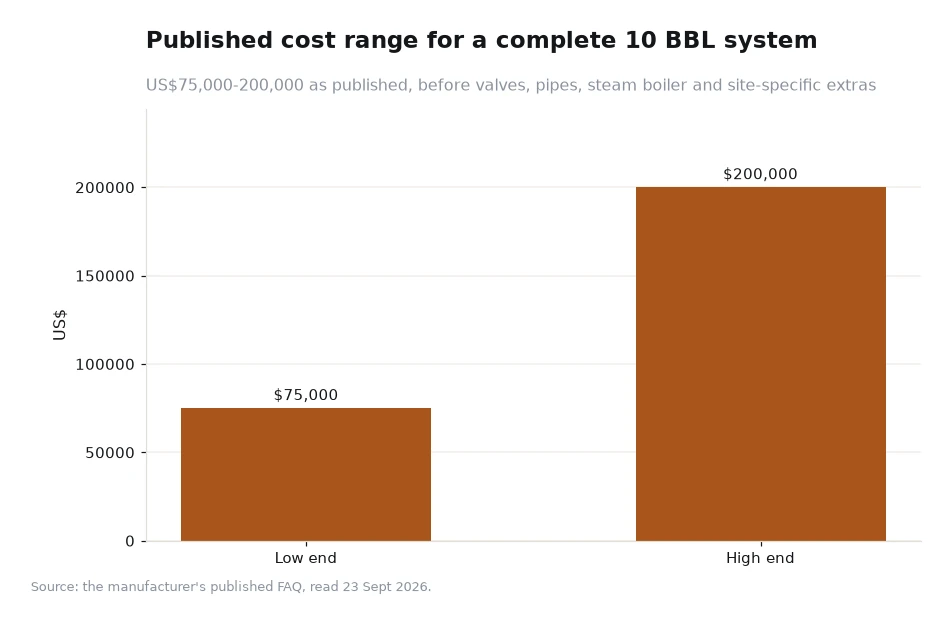
- The manufacturer publishes an example cost range of US$75,000–200,000 for a complete 10 BBL system, before valves, pipes, steam boiler and site-specific extras.
- Pick one dominant format at launch and buy the second line only when the first one is genuinely full.
What each filling route asks of your building
Filling equipment is not a box that sits in a corner. A kegging station wants a level floor, a drain nearby, a pressure source and a route for a pallet or a pallet truck. A bottling or canning line wants a longer run of clear floor, a place for empty containers and closures, a palletised area for finished stock, and cold storage if the beer is to travel. Measure those routes before you measure the machine.
Labour is the second site cost. Filling by hand is possible at small volumes and is how many breweries begin, but the hours pile up quickly once output passes a few thousand litres a month. Published packaging machines for small and mid-sized plants are designed to be run by one or two operators, which is the practical target when you size a line.
A filling line draws on the same services as the brewhouse: steam or hot water, chilled water or glycol, compressed air, carbon dioxide and a drain that can take a sudden release of cleaning solution. The equipment manufacturer lists filling and control systems as part of the standard range, and because those services are sized once for the whole plant, the packaging decision is best made while the utility drawing is still open rather than after the pipework is fixed.
Kegging first: the lowest-commitment route
Kegs are the usual first format, and not only because containers come back. A keg line fills fast, needs no closures or labels, and exposes the beer to little oxygen. For a brewery selling to draught accounts within a delivery radius, the kegging station plus a bright tank is often the whole packaging department.
The catch is the reverse logistics. Every keg you own is capital sitting in someone else's cellar, and a keg fleet has to be tracked, cleaned and rotated. Add that to the plan before you scale the draught side, because a missing keg is a lost sale and a replacement cost at the same time.
Bottles and cans: shelf life, labour and oxygen
Bottles and cans take beer further and hold it longer, which is why they dominate retail. Both add packaging materials, a labelling or printing step and slower filling per litre. Cans are lighter, block light completely, chill quickly and stack well; bottles remain the format many drinkers associate with premium beer and are easier to re-label for a special release.
Whichever you pick, the machine's job is the same: fill predictably, keep oxygen pickup low and hold carbonation. Ask what the line's fill consistency is, how the filler handles a change of container size, and how much beer the cleaning routine consumes between runs. Those three answers matter more than the headline speed of the machine.
How filling kit sits inside a project budget
The published example for a complete 10 BBL system is US$75,000–200,000, and the same page notes that valves, pipes, a steam boiler and other site-specific requirements change the figure. Filling equipment purchased at the same time shares the pump, the pipework, the control cabinet and the commissioning visit, which is where the savings are, rather than in the machine itself.
Treat the filling line as a decision inside the wider equipment list, not as a purchase made a year later. What the manufacturer supplies for a complete brewery covers the mash, fermentation, filtration, control and filling stages, so the packaging scope should appear in the same drawing as the tanks.
| Format | Typical line scope | What it demands on site |
|---|---|---|
| Keg | Keg washer and filler, keg rack, pressure supply | Level floor, drain, pallet access, a tracked keg fleet |
| Bottle | Rinser, filler, crowner, labeller | Long fill run, glass and crown storage, dry stock area |
| Can | Rinser, filler, seamer, date coder | Clear floor, can and lid storage, oxygen control, cold store |
| Mixed | One format first, the second added later | Separate spares and training for each line |
Worked example: filling a 10 BBL batch
Example, with assumptions stated. Take a 10 BBL batch. Using 1 BBL ≈ 117 litres, that is 10 × 117 = 1,170 litres of finished beer. Divide by container size: 1,170 ÷ 30 = 39 thirty-litre kegs, or 1,170,000 ÷ 330 ≈ 3,545 bottles and cans of 330 millilitres, or 1,170,000 ÷ 500 = 2,340 units of 500 millilitres. Losses at the filler, foam and sample pulls reduce all of those numbers, so plan the container order below the theoretical figure.
Now put a line cost next to it. If a filling line represents about 15 per cent of an equipment package, then 0.15 × 75,000 = US$11,250 at the low end of the published range, 0.15 × 200,000 = US$30,000 at the high end, and 0.15 × 137,500 = US$20,625 at the mid-point of that range. The percentages are this article's own example: a keg-only start sits well below them, while a bottle line with a labeller and a can line with a seamer sit above.
Frequently asked questions
Which filling format should a new brewery buy first?
Kegging is the usual first step because it needs the least space, labour and packaging material per litre, and the beer is sold nearby. Bottles and cans follow when retail or wider distribution becomes the plan.
How much beer does a 10 BBL batch fill?
A 10 BBL batch is about 1,170 litres at 1 BBL to 117 litres, which is roughly 39 thirty-litre kegs or about 3,545 containers of 330 millilitres before losses at the filler.
Deciding the order of purchase
Write the packaging route into the same document as the brewhouse and the tanks, with the container sizes, the intended monthly volume and the labour you can spare. Then ask for a proposal that includes the filling stage and the pipework between it and the bright tank, so nothing has to be retrofitted through a wall later.
The wider published list of commercial brewery equipment is a useful checklist for that conversation, and the company history on the about us page shows the markets the machines already serve. When the format is settled, confirm container sizes, voltage and floor layout through the contact page before the order is confirmed.
Facts in this article come from the manufacturer's own website, read 23 Sept 2026: the 23-year history, the published range of tanks, kegging, bottling and canning machines, filtration and control systems, the example cost range of US$75,000–200,000 for a complete 10 BBL system, the 90–150 day deposit-to-door delivery window, and the 6-year warranty on tank accessories and electronic components against manufacturing defects from the factory, used within scope. Container counts and the percentage split are this article's own labelled examples.[1]