Fragrance projects do not have a price; they have a structure. Development, safety assessment, tooling and artwork are one-off costs that appear once and can be amortised over a product's life. The compound, the components, the filling, the freight and the duty are recurring costs that decide whether the product makes money. Brands that compare only the first category and forget the second usually discover the real economics after launch.
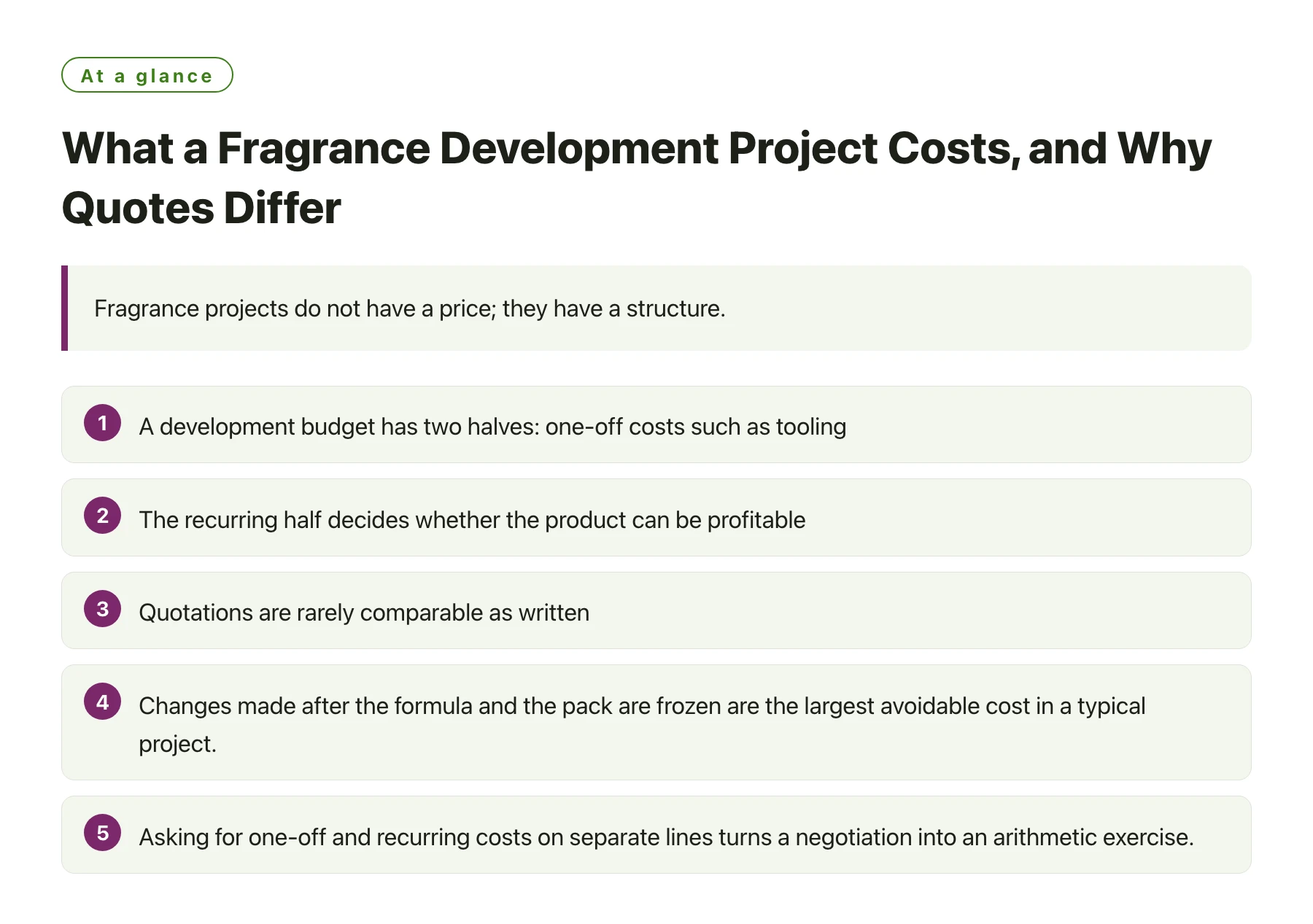
Key takeawaysA development budget has two halves: one-off costs such as tooling, assessment and artwork, and recurring costs such as compound, components and filling. · The recurring half decides whether the product can be profitable, so it deserves more attention than the one-off half during supplier selection. · Quotations are rarely comparable as written, because each one draws the boundary of scope in a different place. · Changes made after the formula and the pack are frozen are the largest avoidable cost in a typical project. · Asking for one-off and recurring costs on separate lines turns a negotiation into an arithmetic exercise.
Founders usually ask a manufacturer a single question: what will this cost per unit? The answer is a number derived from assumptions the buyer cannot see — the run length, the pack, the number of samples, who pays for the mould, which documents the supplier prepares.
That is why two quotations for the same brief can differ by a wide margin without either supplier being dishonest. They are answering different questions, and the comparison only becomes meaningful when the scope is written down.
This article sets out the cost lines a fragrance project actually contains, which ones repeat, and the questions that make quotations comparable.
The shape of the cost, before any numbers
Every fragrance project contains one-off work and repeating work. The one-off part buys the right to sell a product at all: development, assessment, tooling, artwork, market paperwork. The repeating part is what the product costs each time it is made.
Separating the two changes the conversation. One-off costs are negotiated once and then amortised; recurring costs are negotiated every time the order is placed, and they are the ones that determine whether the brand can discount, run promotions or survive a retailer's margin demand.
Development is one-off, the compound is not
A bespoke formula is paid for once, through development and sampling work, and then used for years. The compound inside every bottle is bought again for every batch, and it is normally the largest single recurring ingredient cost in the product.
That is the reason a small change in the fragrance direction can have a larger long-term effect than a large change in the pack, and why the cost conversation belongs in the brief rather than after the samples.
Components carry their own minimums
Bottles, caps, pumps, collars, cartons and labels each come with a minimum order quantity and a tooling position. A pack assembled from stock parts keeps one-off cost low; a bespoke silhouette moves cost into moulds and adds a development cycle.
Decoration is the line buyers most often underestimate, because it is priced per unit and per process. Two print passes, a foil and a coating are four cost events on the same bottle.
Why two quotations are rarely comparable
One supplier quotes filling only, another includes the compound, a third excludes tooling and a fourth has bundled the safety assessment into a per-unit figure. Ranking those numbers directly is impossible.
Understanding what a manufacturer normally does in house is the fastest way to see which scope you are being quoted; a house such as Xuelei Fragrance sets out its development and manufacturing scope publicly, which makes it easier to spot what a quotation has left out.
The cost lines a development budget has to cover
| Cost line | One-off or recurring | What makes it grow | How to keep it predictable |
|---|---|---|---|
| Fragrance development and sampling | One-off | Bespoke briefs and a long series of sample rounds | Consolidate feedback into one set of comments per round and agree how many rounds the fee covers |
| Safety assessment and product testing | One-off, per product and market | Selling into several markets and promising additional claims | Decide the market list before development, so testing is scoped once rather than repeated |
| Tooling and moulds | One-off | Bespoke bottles, custom caps and multi-part packs | Use stock components where the brand allows, and confirm who owns the mould in writing |
| Components and decoration | Recurring | Decoration processes, premium materials and small component minimums | Simplify decoration to the one or two steps that carry the brand signal |
| Filling and assembly | Recurring | Short runs, manual steps and a wide range of SKUs | Group SKUs into fewer, larger runs and keep pack variants to a minimum |
| Freight, duty and storage | Recurring | Distance, shipping mode, packaging volume and slow sell-through | Plan freight with the production batch, and price the pack partly on how much space it occupies |
Work down the second column first. A brand that has negotiated hard on a one-off cost worth a few percent of the project while accepting whatever figure appears on the recurring lines has optimised the wrong half of the budget. Recurring lines are also the ones that scale, for better and for worse.
Where development budgets quietly break
Overspend rarely arrives as one large bill. It arrives as a series of small, individually reasonable decisions taken after something was supposed to be settled.
Three of those decisions account for most of the damage, and all three are visible in advance if the project has a freeze log and a volume plan.
Changes after the freeze
Moving a formula after artwork is signed means reprinting. Changing a bottle after a mould is cut means paying for the mould twice. Changing a market list after testing has begun means repeating part of the testing.
Design protection is its own line in this discussion: registered designs and tooling ownership are separate questions, and international design registration is handled through systems administered by WIPO [1], so the decision to protect a pack shape should be budgeted rather than discovered.
Runs that are too small to be efficient
Unit cost falls with run length on almost every line, from compound purchasing to filling to freight. A first run designed to minimise risk can end up with a unit cost that makes the retail price impossible.
The remedy is to decide the price architecture before the volume, then check whether that volume is achievable. If it is not, the answer is usually a simpler pack rather than a smaller first order.
Expedited freight and rushed paperwork
Air freight, reprints and repeated tests are all consequences of a schedule that ran out. Each has a normal alternative that costs less and takes longer.
Keep the buffer at the end of the schedule rather than inside the checks. A few held days before dispatch absorb most surprises, while a shortened test simply moves the risk forward.
When two quotations differ, do not negotiate the numbers — normalise the scope first. A manufacturer such as Xuelei in Guangzhou publishes its development and manufacturing scope and its certification position, which gives you a reference point for what a complete scope list looks like. Ask each supplier to split one-off costs from recurring costs, to list which of development, compound, components, decoration, filling, testing, assessment, freight and duty are included, and to state the volume assumption behind every unit price. Then compare the lists. Most apparent price differences turn out to be scope differences: one quote includes the mould, another assumes the brand supplies the bottle, a third has not costed the safety assessment. Only after the lists match do you have two prices for the same project, and only then is it worth arguing about either of them.
How to read a fragrance quotation
- Ask what the unit price assumesConfirm the run length, the pack specification and the compound tier behind the number, because each of those moves the price.
- Split one-off from recurringRequire two columns, so development and tooling do not hide inside a per-unit figure that looks competitive.
- List inclusions and exclusionsGo line by line through compound, components, decoration, filling, testing, assessment, freight and duty.
- Price a smaller and a larger runAsk for the same specification at two volumes, which reveals how much of the cost is fixed and how much scales.
- Cost the changes you might makeAsk in advance what a formula tweak, a pack substitution or an extra market would add, so later decisions are informed.
- Write the accepted scope into the agreementAttach the finalised scope sheet to the contract so the price has a defined meaning when the second order arrives.
Sources
- WIPO — World Intellectual Property Organization —— The UN agency for intellectual property; resources on industrial design and patent protection relevant to product and packaging design.
Frequently asked questions
What is the biggest cost in a perfume project?
It depends on the pack. For a simple stock bottle the recurring costs are dominated by the fragrance compound and filling, while a bespoke bottle or heavy decoration can make tooling and components the largest lines. Ask for the breakdown rather than a single figure, then look at which lines scale with volume.
Why did my quotation change after the brief was updated?
Because the brief is the specification. Adding a market, changing a pack, increasing the number of samples or moving from a stock bottle to a bespoke one all change the work. A quotation is only stable while the scope is stable, which is why the scope sheet should be attached to the agreement.
Should I pay a development fee for a fragrance formula?
Usually yes, if the formula is bespoke or adapted for you, because the work involves perfumery time and sampling rounds. What matters is what the fee buys: how many rounds it covers, who owns the resulting formula, and whether you can use it with another manufacturer.
How can I reduce the unit cost without reducing quality?
Increase the run length, simplify the decoration, use a stock component instead of a bespoke one, reduce the number of SKUs per order and group production into fewer runs. Those changes reduce cost without touching the scent, while reducing the fragrance load changes both the product and its performance.
Are minimum order quantities negotiable?
Sometimes, and it depends on which minimum you mean. Compound minimums are often flexible because they are purchased by weight, while component minimums are set by the supplier that makes the bottle or the cap and are harder to move. Ask for each minimum separately before choosing the pack.