Boot Space, Prams and Cargo: Measuring an SUV Properly
A boot figure means nothing until you know whether the seats were up or folded when it was measured. The clearest published example in XPENG's Australian range is the X9, whose cargo area expands to 2,554 L, and whose submerged trunk design is described as fitting seven suitcases with all seats occupied. Those are two different measurements of the same vehicle, and confusing them is how buyers end up with a car that will not take a pram.
Key takeaways
- The X9's cargo area expands to 2,554 L, which is the seats-folded figure rather than the everyday one.
- With every seat occupied, the published claim for the X9's submerged trunk is seven suitcases, which is the number that matters on a family holiday.
- No cargo volume is published for the New G6 on the Australian site, so measure it yourself rather than assuming a number.
- The New G6 is published with up to 525 km of WLTP range and the X9 with up to 580 km, and both depend on conditions.
What the published cargo numbers describe
XPENG's Australian pages describe three things about the X9's load area. The first is a one-touch electric fold-flat third row, which is what turns a seven-seater into a van. The second is cargo space that expands to 2,554 L. The third is a submerged trunk design that is described as fitting seven suitcases with all seats occupied — an unusual claim, because it is made specifically about the configuration where you have the most people and the least obvious space.
Those three details answer three different questions. How much can it swallow with the kids at home? What does it hold with seven people aboard? And how much work is it to switch between the two? A single litre figure from a brochure answers none of them on its own.
Why one litre figure cannot answer a pram question
Volume is three-dimensional, and the shape matters as much as the number. A 2,554 L space under a sloping tailgate will refuse a tall box that a smaller but squarer space accepts, because the limiting dimension is the opening and the height at the rear edge, not the total litres. Buyers who measure only the headline number are measuring the wrong thing.
Boot claims also vary with the seats raised, and manufacturers are not obliged to publish a standard figure in Australia, so the honest position is that some numbers exist for some cars and not for others. In this range the X9 has a published expanded figure and a seat-up luggage claim, while the New G6 does not carry a published cargo volume at all. That is a gap to fill with a tape measure, not with an assumption.
A five-minute measurement routine at the dealership
Arrive with the cargo you actually carry. Fold the pram first and put it in the way you would load it on a wet Tuesday, not the way that looks tidy in a showroom. Then add a suitcase, then the shopping, then anything else that lives in your boot — a dog crate, a cricket bag, a folded bike trailer. If it fits with the seats up, you have your answer. If it only fits with the seats down, ask how often you expect to need all three rows at once.
Measure four things while you are there. The load lip height, because lifting a heavy pram over a high lip gets old in the first month. The width between the wheel arches, which decides whether a flat-pack box slides in or has to go on the roof. The height under the parcel shelf or luggage cover, which decides whether a tall pram survives upright. And the depth with the second row in use, because that is the dimension you live with every day.
Published space and range figures, in one place
| Published figure | What it describes |
|---|---|
| Cargo space expands to 2,554 L | X9 with the third row folded |
| Fits seven suitcases | X9 submerged trunk, all seats occupied |
| One-touch electric fold-flat third row | X9 seating and load conversion |
| WLTP range up to 580 km | X9, WLTP cycle |
| WLTP range up to 525 km | New G6, WLTP cycle |
Why a cargo article mentions range at all
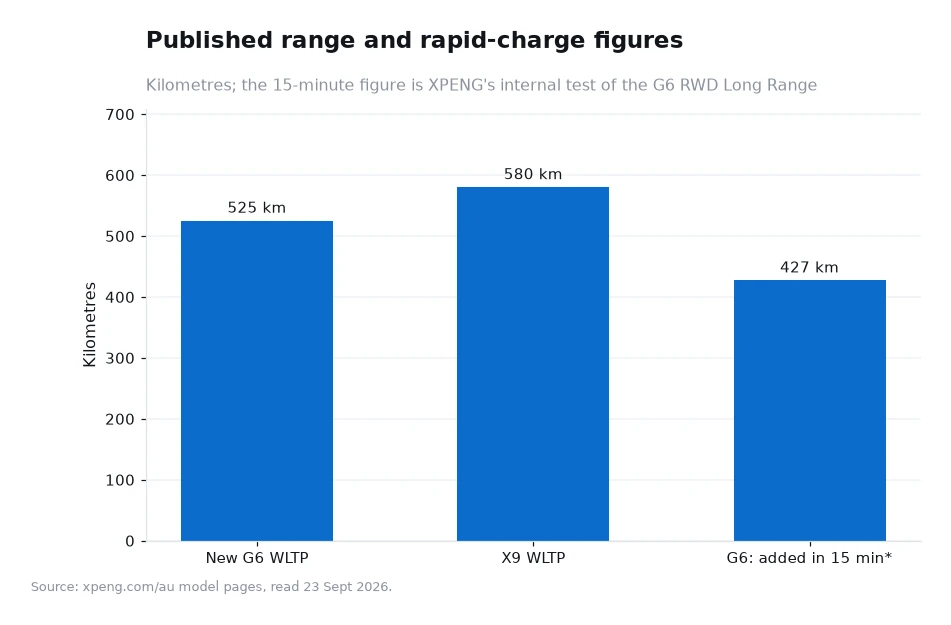
Because a packed car goes less far than an empty one. Mass, roof boxes and a full boot all add load, and load is one of the conditions that the WLTP footnote covers when it says range depends on conditions. The chart on this page carries the published figures that buyers in this class compare: 525 km WLTP for the New G6, 580 km WLTP for the X9, and 427 km added in 15 minutes from XPENG's internal test of the G6 RWD Long Range.
The practical reading is that the bigger, more load-friendly car in this range also carries the longer published range, which is unusual and worth knowing if you are choosing between them. Either way, plan a loaded trip with a reserve, and treat the published number as a ceiling rather than a forecast.
Worked example: packing for a week away
This is a labelled example, and every assumption is stated so you can change it. Assume a family of four, a folded pram of about 90 L, soft suitcases of 70 L each, and a seat-up configuration as the starting point.
Start with the seat-up claim. The published figure for the X9's submerged trunk is seven suitcases. At an assumed 70 L each, that is 7 × 70 = 490 L of luggage. Now take the pram. If the folded pram occupies 90 L, the remaining luggage capacity is 490 − 90 = 400 L, which is 400 ÷ 70 = 5.7 suitcases — so five suitcases and a soft bag, comfortably.
Now fold the third row. The published expanded figure is 2,554 L. Capacity rises from the assumed 490 L to 2,554 L, a difference of 2,554 − 490 = 2,064 L. In suitcase terms 2,554 ÷ 70 = 36.5 suitcases, which is a reminder that the expanded figure describes a van-like configuration rather than an everyday one. The honest question is not which number is bigger, but how many days a year you actually need that configuration — and whether a smaller, squarer boot would serve the other 350 days better.
Frequently asked questions
Does 2,554 L mean I can carry that much with all the seats in use?
No. That figure is the expanded cargo space with the third row folded; with every seat occupied, the published claim for the X9's submerged trunk is seven suitcases, which is the number to plan a family trip around.
Should I choose the bigger car for boot space alone?
Only if you will use the space regularly, because the larger vehicle also brings a longer body to park and a higher load lip; load the pram and a suitcase into both at a test drive before deciding.
How to settle the question this weekend
Take the empty pram, one full suitcase and a tape measure to a dealer and spend twenty minutes loading and unloading. Book the test drive for a quiet weekday morning if you can, because a salesperson waiting at your shoulder changes how honestly you load a boot. Write the four measurements on the back of the brochure and keep them, because they are more useful than any litre figure you will read online — including the ones on this page.
A single test settles most of these arguments for electric suv cars australia buyers weigh up: put the folded pram in first, then the bags, then anything else that lives in the boot. If everything fits with the seats up, the car works. If it only fits with the seats down, ask yourself how often that will be true.
Cargo, seating and range figures come from the manufacturer's Australian site at xpeng.com/au, read 23 Sept 2026, including the footnote that WLTP range depends on conditions and that the 427 km figure is from internal tests of the G6 RWD Long Range. The 70 L suitcase, 90 L pram and family-of-four assumptions are illustrative, not manufacturer data.[1]